Travel Notes / 2026 ・ No.03
Enoshima and Kamakura in a Day
A hanging monorail to the island, a walk along the shore, then the Enoden to the Great Buddha and the old capital
Published
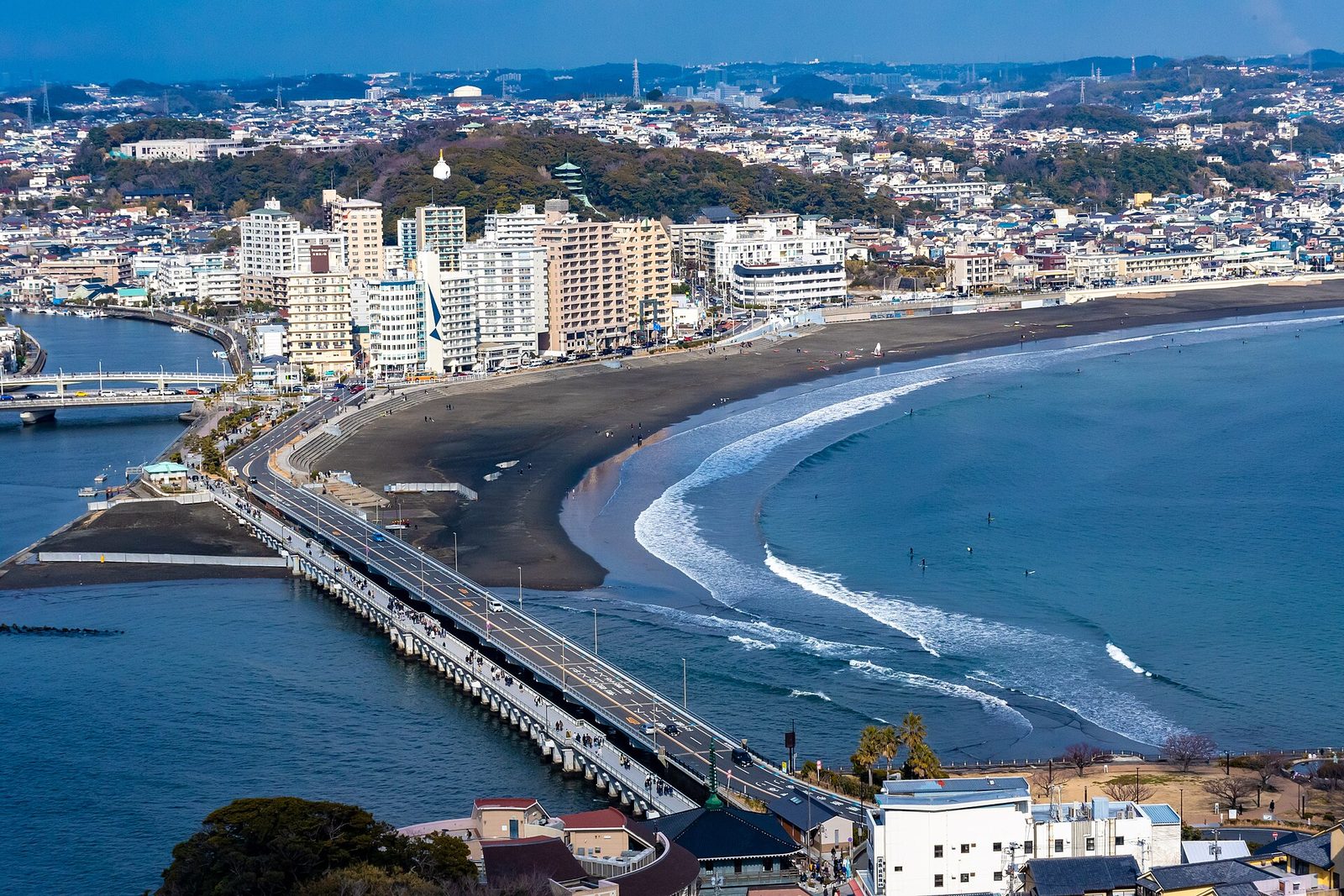
Leave Tokyo at eight and change at Ofuna for the suspended Shonan Monorail to Enoshima.
Loop the island, then walk the coast to the famous crossing at Kamakura-Kokomae; take the Enoden
to Hase for the Great Buddha and Hase-dera, and end in Kamakura. Timed to each train and stop.
How the route works
The route runs one way, west to east, from Enoshima to Kamakura. You go out by monorail from Ofuna down to Enoshima and come back from Kamakura on JR. Nothing is doubled back, so the trains are part of the fun.
Three ideas shaped it:
- Enoshima in the morning — the island is all steps and slopes and has to be walked. Get out to the caves at the far end while it is quiet, then rest over lunch
- Walk from Enoshima to Kamakura-Kokomae — it is two stops by train, but only about 35 minutes on foot along the seafront road, with the sea on your right all the way to the crossing
- Flex the second half along the Enoden — trains run roughly every 14 minutes in the day. Build around the Great Buddha and Hase-dera, and add or drop stops as your legs and the clock allow
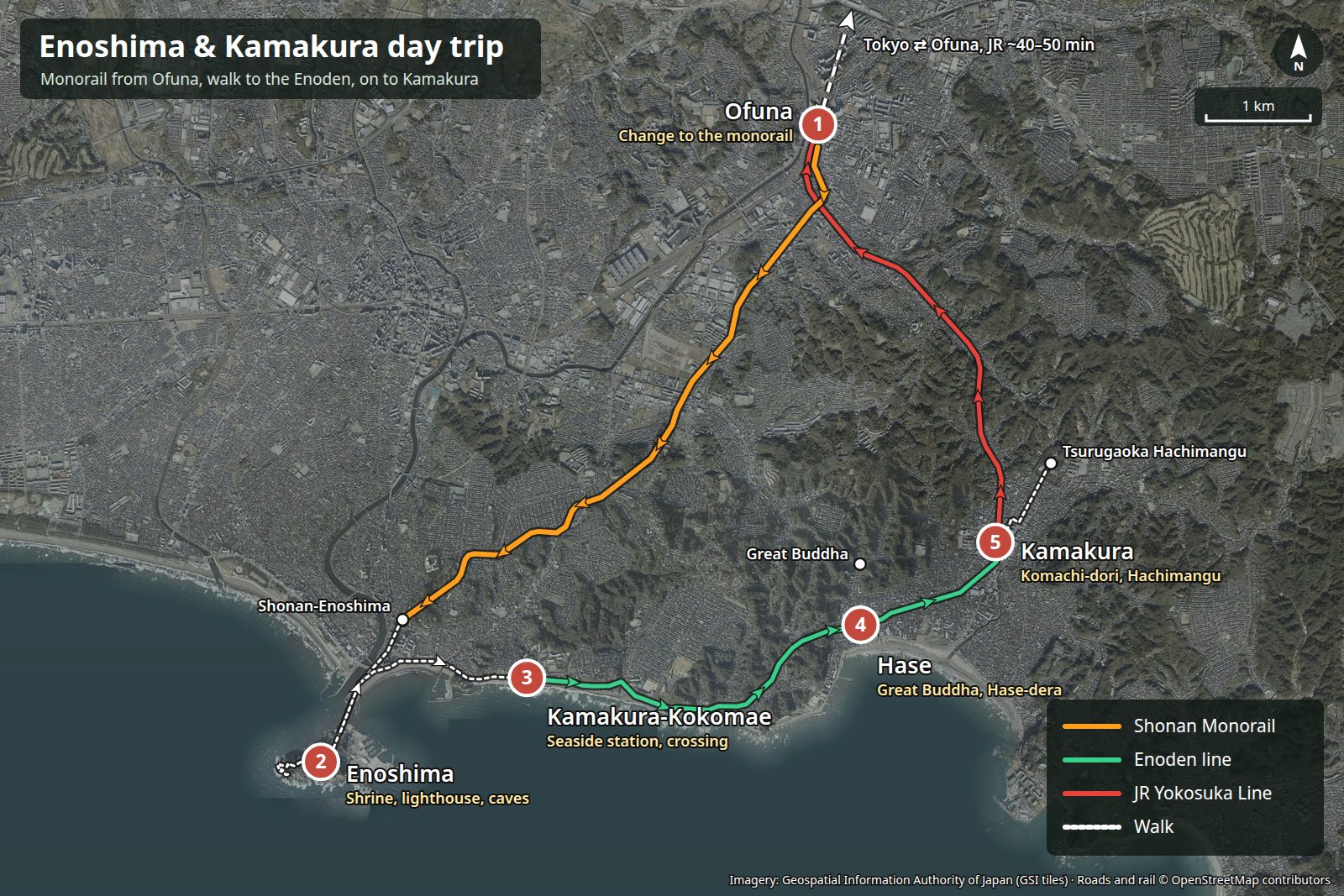
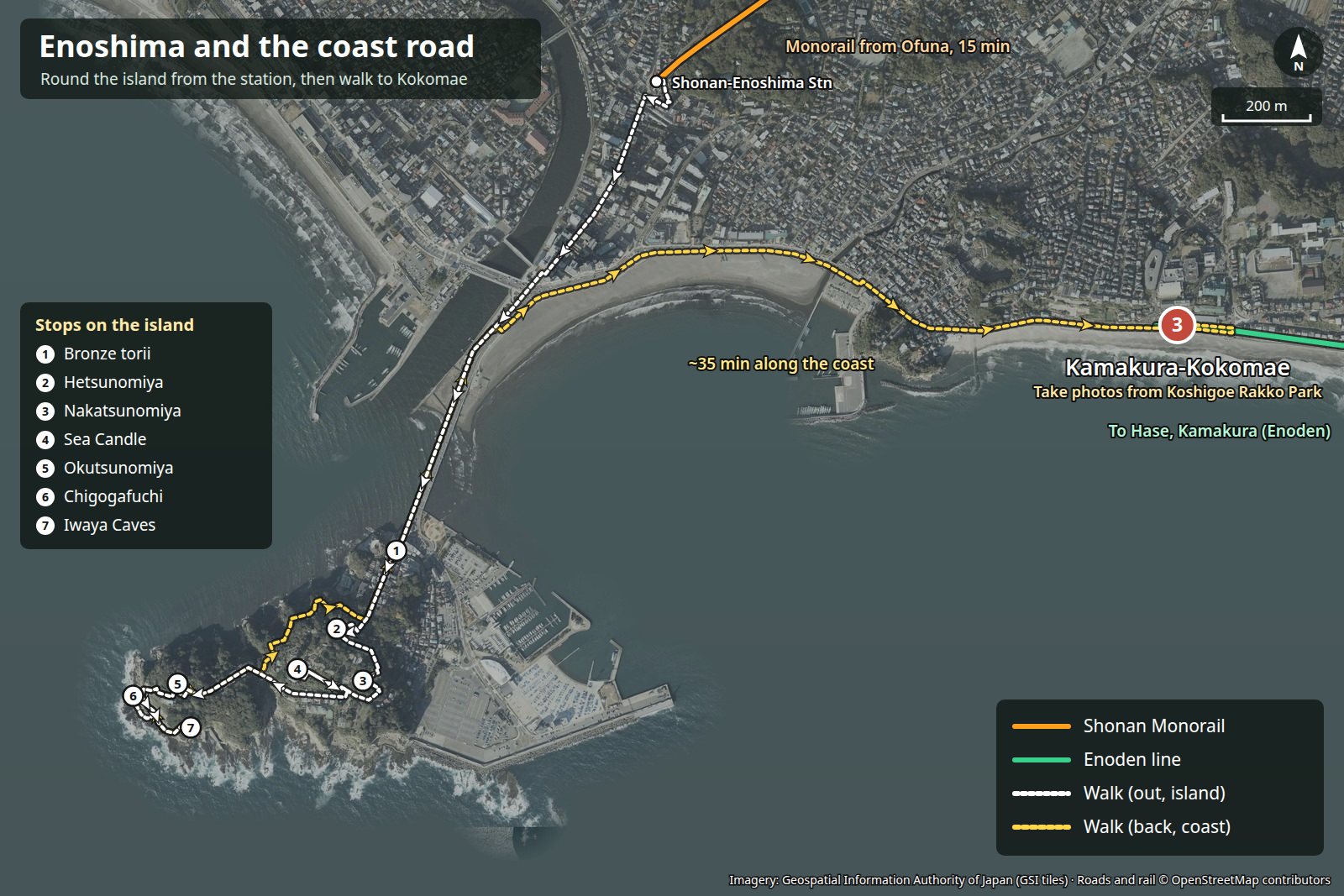
The five stops, in map order:
| No. | Stop | In a line |
|---|---|---|
| ① | Ofuna (Shonan Monorail) | A monorail that hangs from its rail |
| ② | Enoshima | Shrine, lighthouse deck, caves, whitebait |
| ③ | Kamakura-Kokomae | A seaside station and the anime crossing |
| ④ | Hase | The Great Buddha and Hase-dera |
| ⑤ | Kamakura | Komachi-dori and Tsurugaoka Hachimangu |
The day, hour by hour
Take the 8:05 Tokaido Line from Tokyo and reach Shonan-Enoshima at 9:07. Explore Enoshima until early afternoon, walk the coast to Kamakura-Kokomae, then the Enoden to Hase and Kamakura, and the 18:13 Yokosuka Line from Kamakura, into Tokyo at 19:06.
How the day splits (numbers match the map)
One example, checked against the Saturday timetable for October 2026
| Time | Leg | How / how long | Notes |
|---|---|---|---|
| 08:05 | Tokyo → Ofuna (08:44) | JR Tokaido Line, 39 min | Same train from Shinagawa or Yokohama |
| 08:52 | ① Ofuna → Shonan-Enoshima (09:07) | Shonan Monorail, 15 min, ¥340 | Exit the JR gates to change. Stand at the front window |
| 09:07 | Station → bronze torii | Walk, about 20 min | Over the Benten Bridge |
| 09:30 | ② Approach, Hetsu-miya, Nakatsu-miya | About 40 min | Hoanden opens 8:30 |
| 10:15 | ② Samuel Cocking Garden, Sea Candle | About 45 min | Garden free; deck ¥800 |
| 11:10 | ② Okutsu-miya | About 15 min | West along the ridge |
| 11:30 | ② Chigogafuchi, Iwaya caves | About 45 min | Caves ¥500 |
| 12:15 | Caves → approach | Walk, 25–30 min | Back over the island; many steps |
| 12:45 | ② Lunch (whitebait bowl) | About 45 min | On the approach or by the bridge |
| 13:30 | Enoshima → Kamakura-Kokomae | Walk, about 35 min (2.5 km) | Seaward pavement of Route 134 |
| 14:05 | ③ The Kamakura-Kokomae crossing | About 20 min | Take photos from Koshigoe Rakko Park |
| 14:31 | Kamakura-Kokomae → Hase (14:46) | Enoden, 15 min, ¥220 | About every 14 min. Sit on the right |
| 14:55 | ④ Kotoku-in (Great Buddha) | About 40 min | 7 min walk from Hase |
| 15:45 | ④ Hase-dera | About 35 min | Last entry 16:30 |
| 16:25 | Hase → Kamakura (16:29) | Enoden, 4 min, ¥200 | If packed, walk it in 20–25 min |
| 16:35 | ⑤ Komachi-dori, Hachimangu | About 1 hr 25 min | Shrine is 10 min from the station |
| 18:13 | Kamakura → Tokyo (19:06) | JR Yokosuka Line, 53 min, ¥1,040 | No change. Next: 18:21 (arr. 19:18) |
The 08:12 Tokaido train (Ofuna 08:53) also works: catch the 09:00 monorail and you are at Shonan-Enoshima by 09:15. Monorails run every 7–8 minutes in the day, so there is no need to rush the change.
Tickets and budget
You start and finish at different stations and ride the Enoden only twice, so a transport IC card (Suica, Pasmo and the like) is simpler and cheaper than any pass. JR, the monorail and the Enoden all take IC cards.
| Item | Per adult | Notes |
|---|---|---|
| Tokyo → Shonan-Enoshima (JR + monorail) | ¥1,250 | Monorail ¥340 of that. ¥1,242 by IC card |
| Enoshima Shrine, Hoanden | ¥200 | The shrines themselves are free |
| Enoshima Sea Candle | ¥800 | Samuel Cocking Garden is free |
| Enoshima Iwaya caves | ¥500 | |
| Enoden, Kamakura-Kokomae → Hase | ¥220 | |
| Kotoku-in (Great Buddha) | ¥300 | ¥50 extra to go inside |
| Hase-dera | ¥400 | |
| Enoden, Hase → Kamakura | ¥200 | |
| Kamakura → Tokyo (JR) | ¥1,040 | Direct on the Yokosuka Line |
| Lunch and snacks | ¥2,500–3,500 | A whitebait bowl is about ¥1,500–2,500 |
| Rough total | About ¥8,000 | Souvenirs extra |
If you ride the outdoor escalators, the Escar (uphill only, ¥500 for all three sections), the Enoshima 1day ticket (¥1,550), which bundles the Sea Candle, the Escar, the caves and more, works out cheaper. Prices are as published or quoted in September 2026.
① The Shonan Monorail
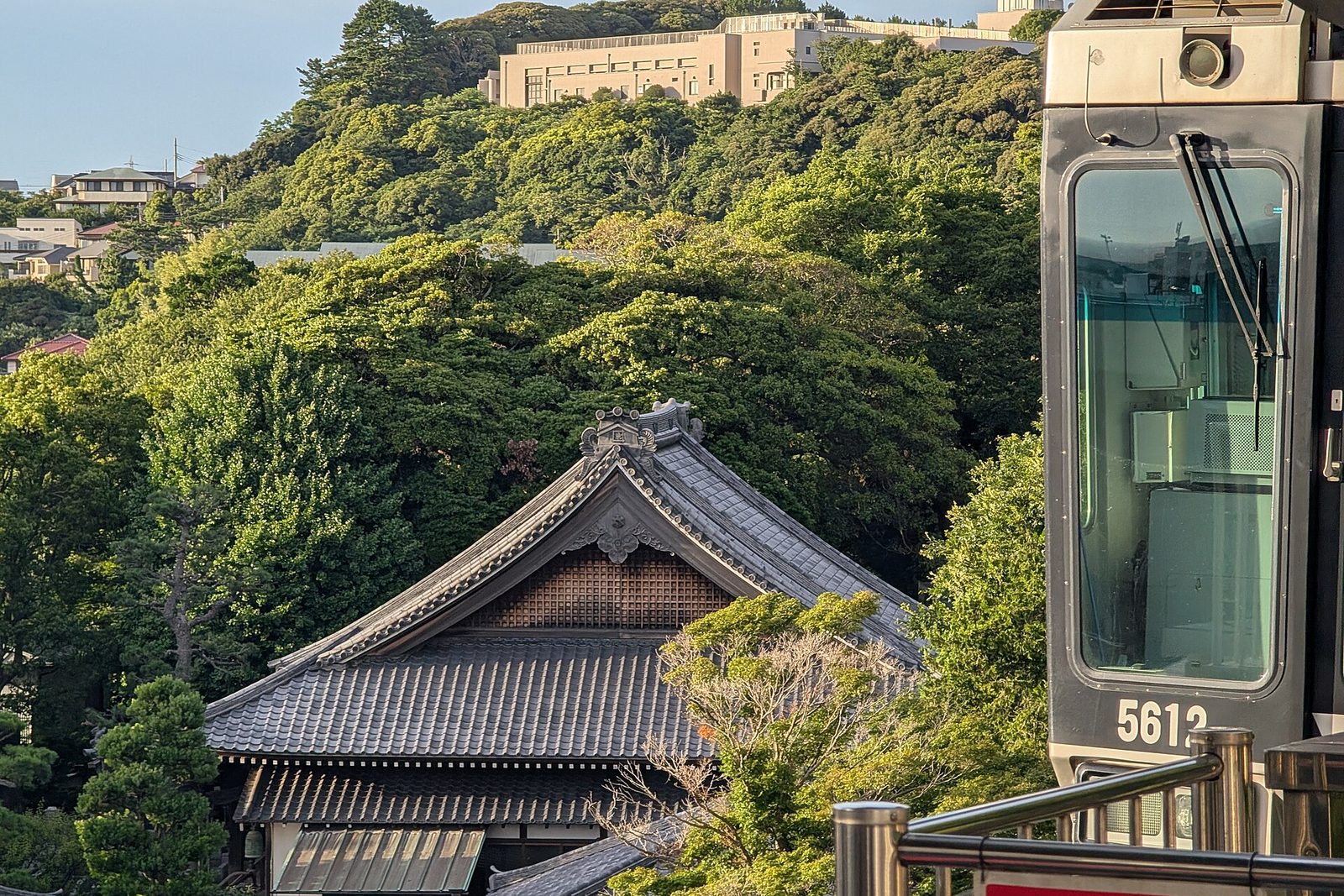
At Ofuna, leave the JR gates and follow the signs to the Shonan Monorail, which covers the 6.6 km and eight stations to Shonan-Enoshima in about 15 minutes. It opened in 1970 and reached Shonan-Enoshima in 1971.
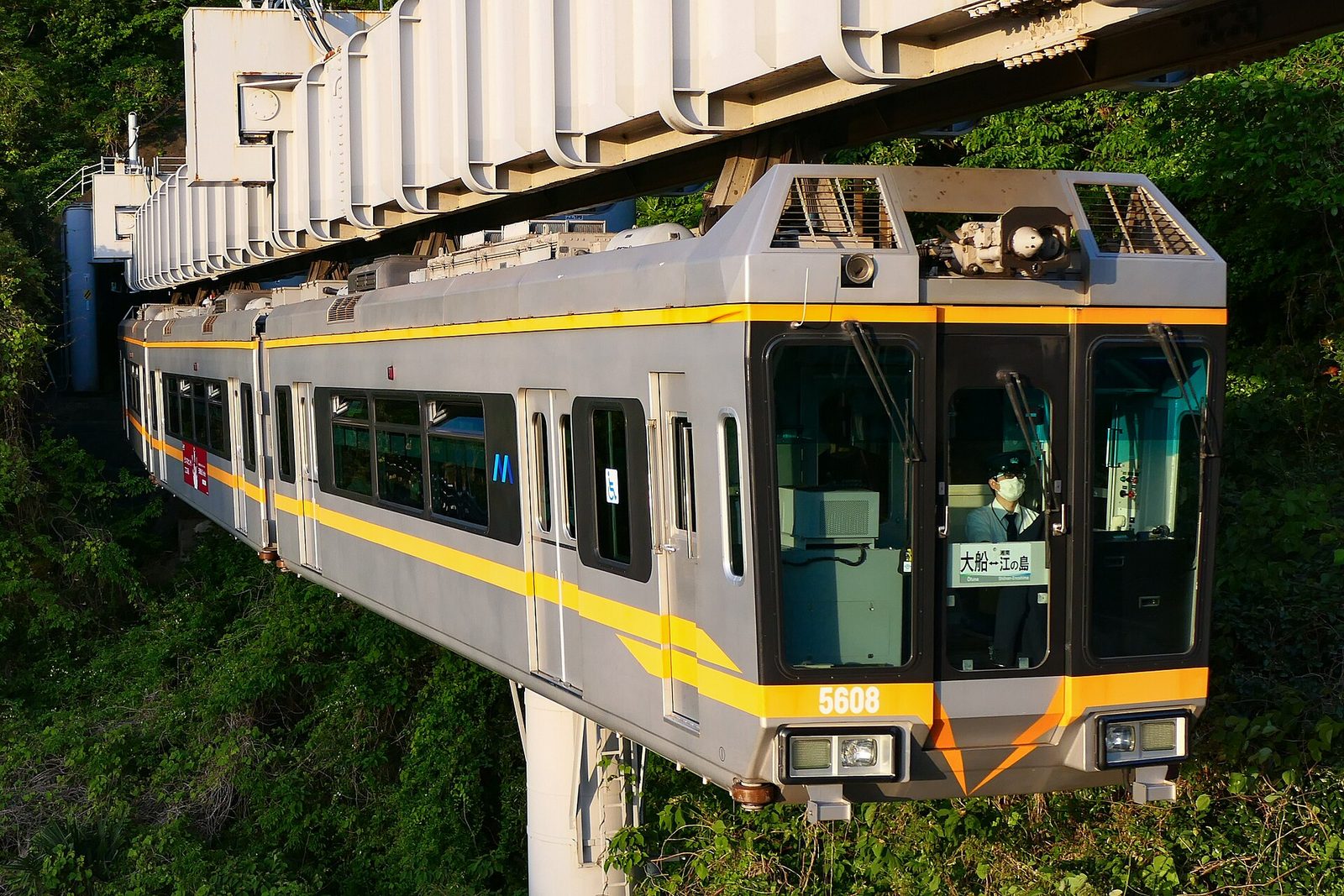
This is a suspended monorail: the cars hang from a rail overhead, so there is no track under you, just rooftops and woods below the window. With its climbs, dips, curves and tunnels it is sometimes called a roller coaster in the sky. There are other ways to Enoshima, but this ride alone justifies going via Ofuna.
- Ride at the front — from behind the driver you can watch the rail swoop over the hills. If it is crowded, let one train go
- The view — houses below for the first half, then the line winds down through wooded hills towards the sea
- The terminus — Shonan-Enoshima is on the fifth floor of the station building, where a small roof terrace looks out over Katase
② Enoshima: the approach and the shrine
From the station, walk through Katase to the sea and over the Enoshima Benten Bridge. At the far end the verdigris bronze torii greets you, and beyond it a sloping street of souvenir shops and restaurants.
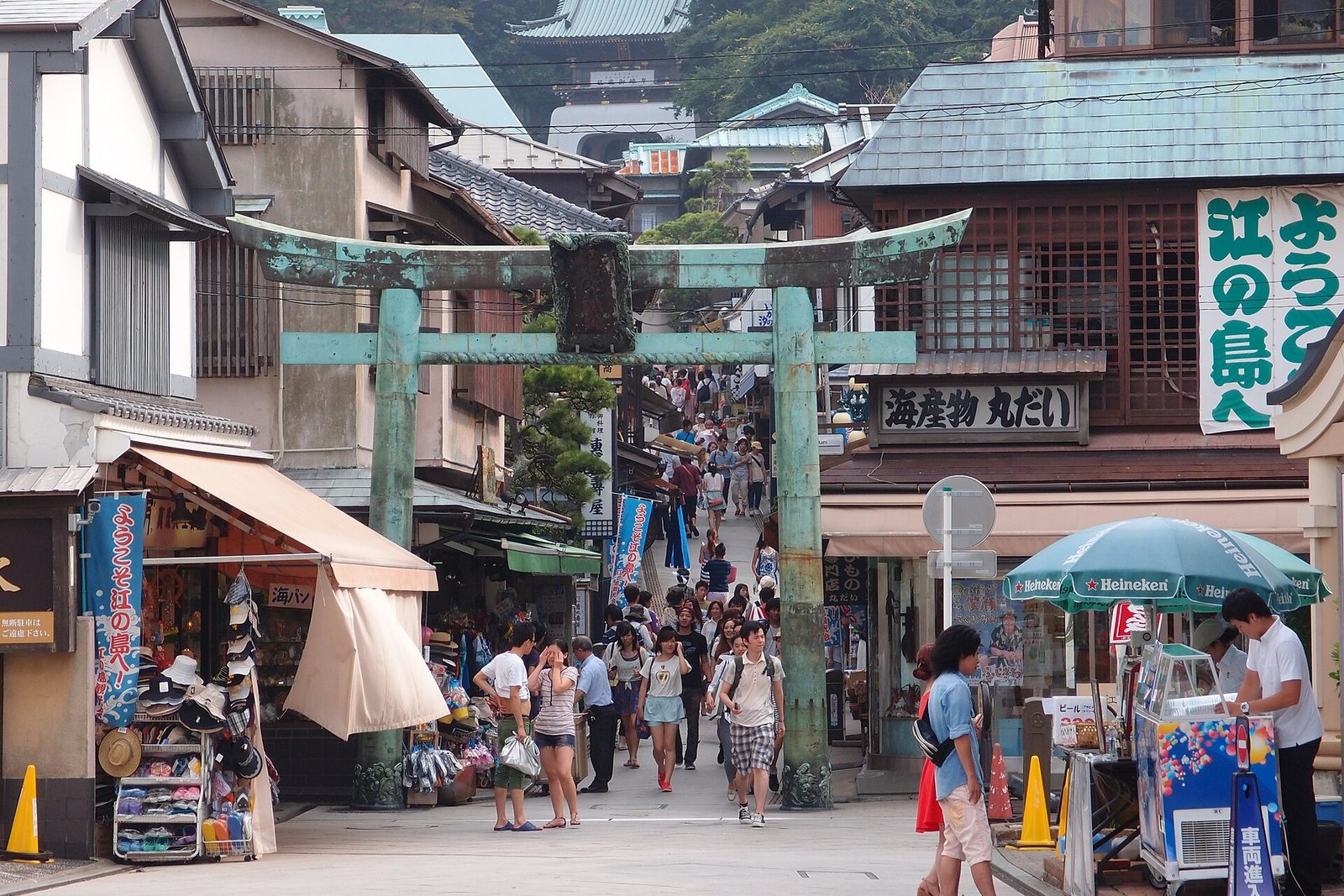
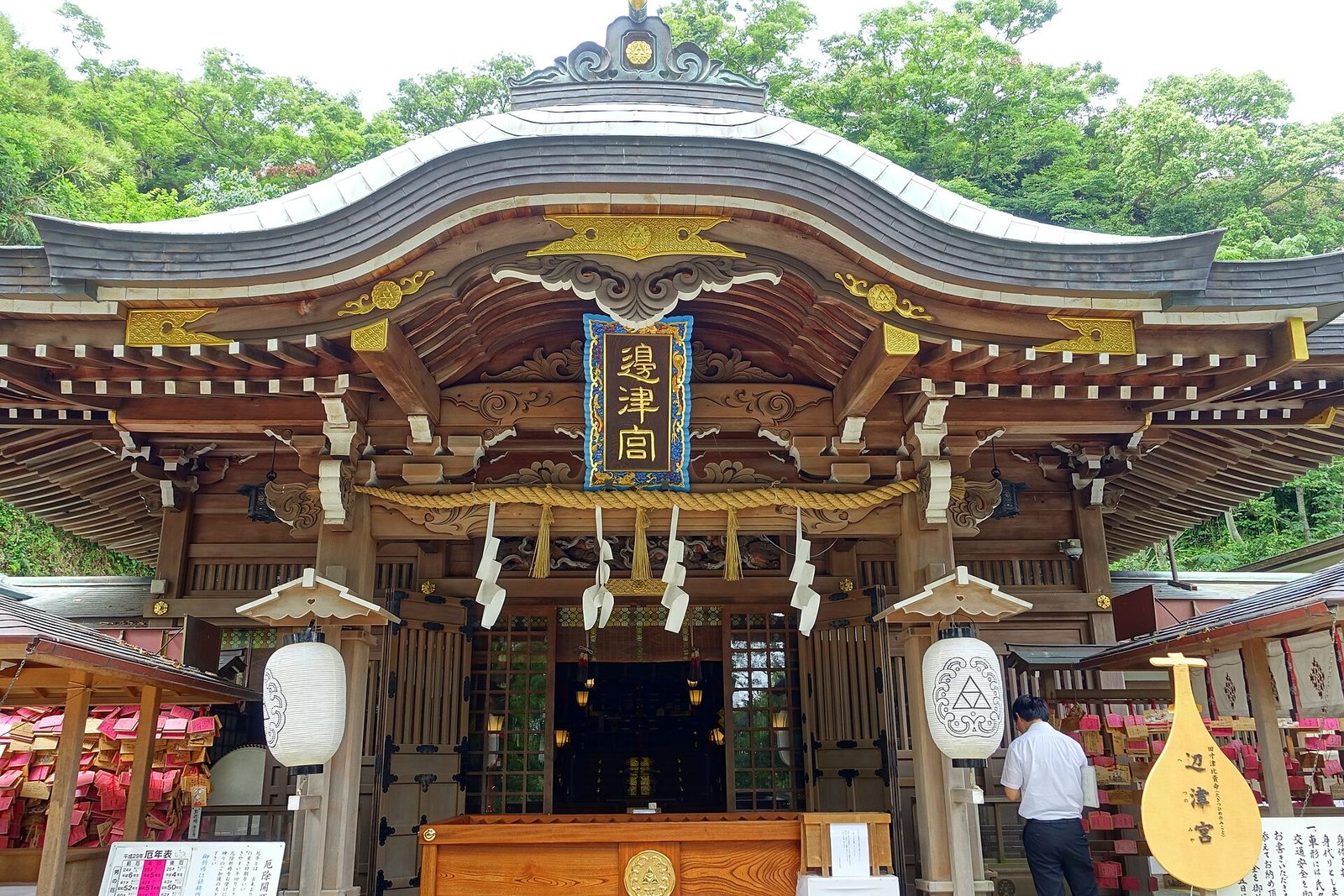
The whole island is in effect the precinct of Enoshima Shrine. Its three shrines, Hetsu-miya, Nakatsu-miya and Okutsu-miya, are visited in turn as you climb deeper into the island. Its Benzaiten is counted among the three great Benzaiten of Japan, long worshipped as a deity of the arts and of fortune.
- Hetsu-miya — the first shrine at the top of the approach. The Hoanden beside it holds an eight-armed Benzaiten (an Important Cultural Property) and a Benzaiten holding a lute (8:30–16:30, ¥200)
- Nakatsu-miya — a bright vermilion hall a flight of steps further up
- The Escar — if the steps are too much, outdoor escalators carry you to the top of the island (uphill only)
② Enoshima: Sea Candle to the caves
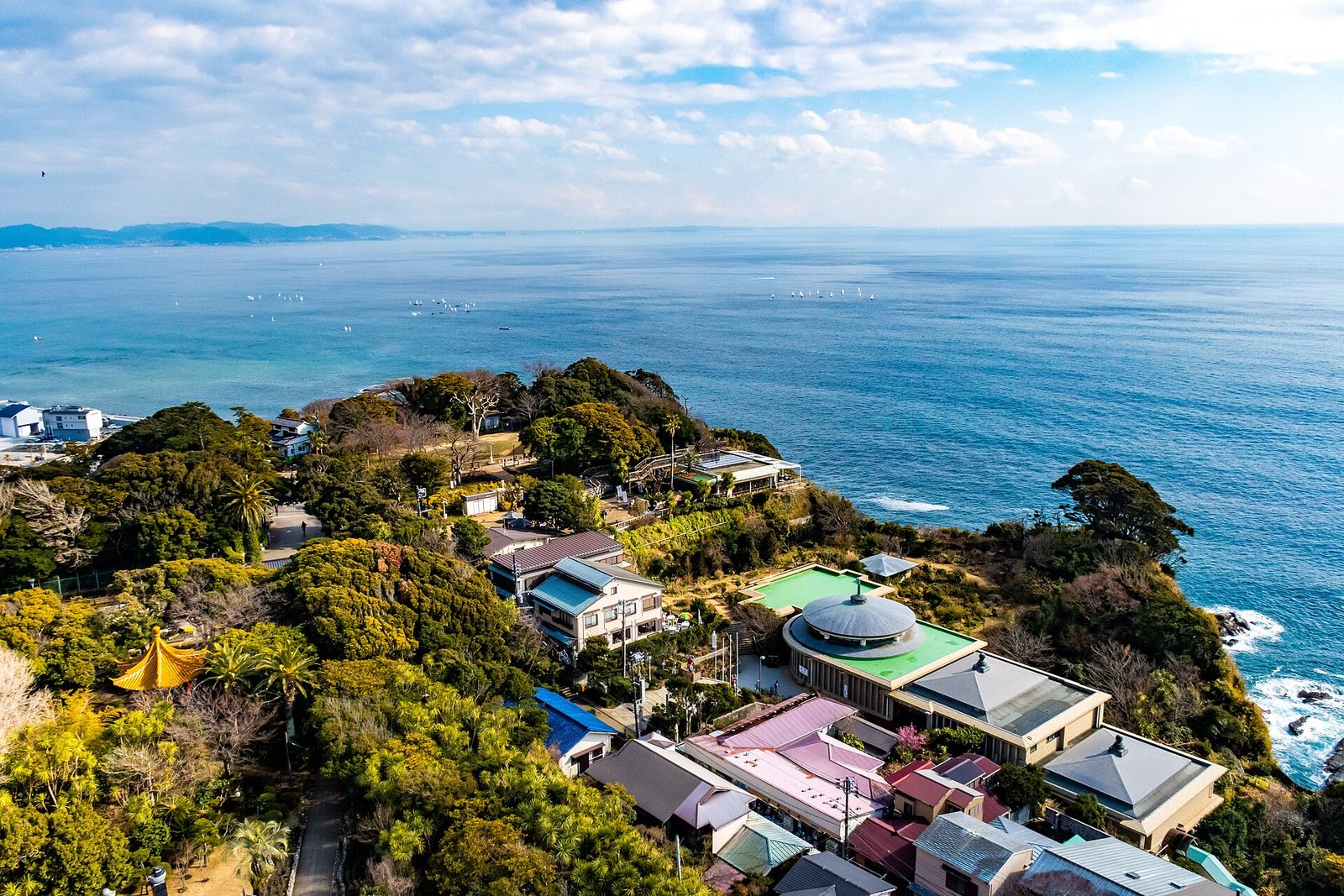
Past Nakatsu-miya you reach the Samuel Cocking Garden at the top of the island, the site of a garden laid out in the Meiji era by the British merchant Samuel Cocking and now a free botanical garden. In the middle stands the Enoshima Sea Candle, an observation lighthouse.
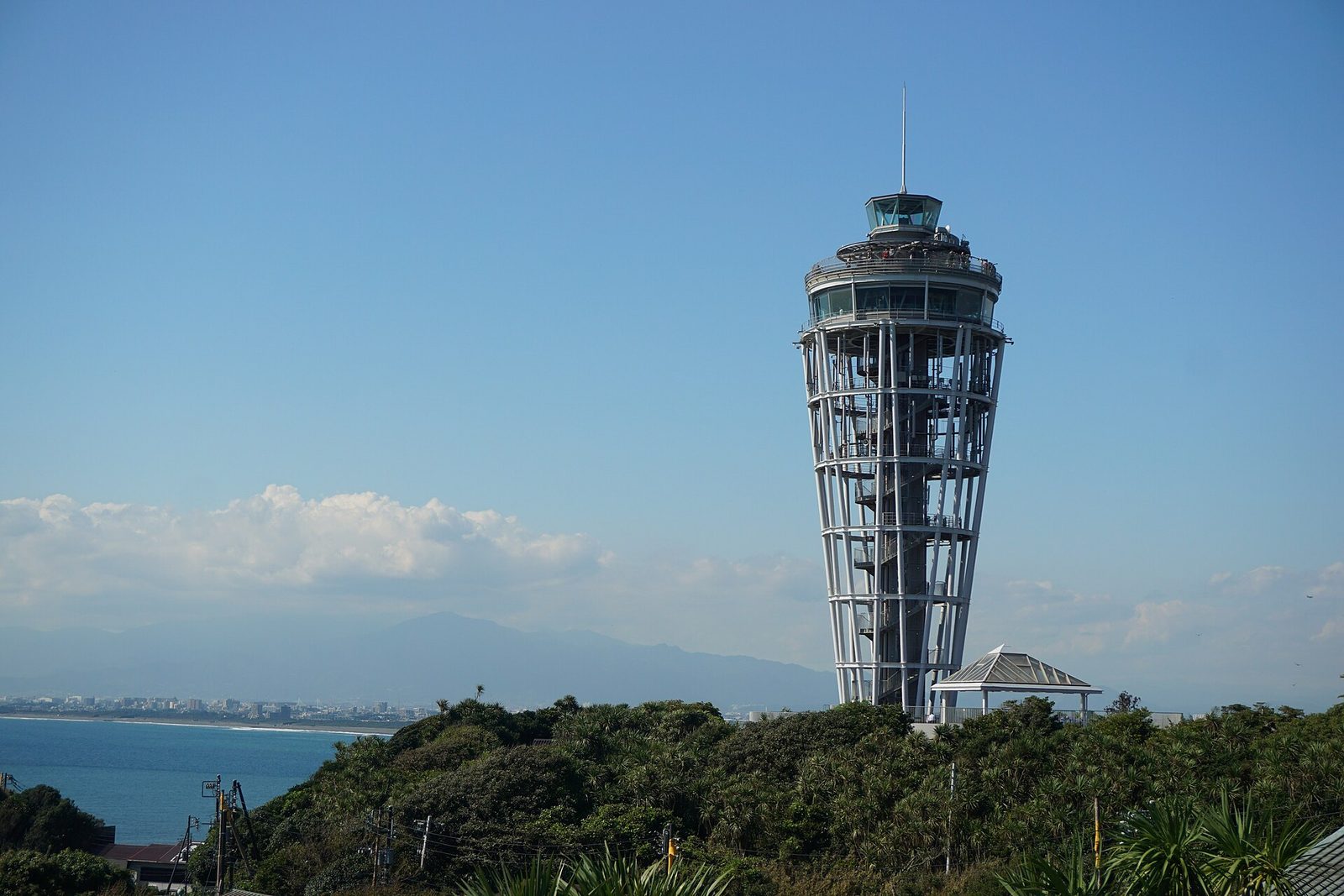
The deck gives you a full 360 degrees of Sagami Bay: the Katase beaches, Kamakura and the Miura Peninsula one way, the Hakone hills the other, and on clear days Mt Fuji and Izu Oshima. From here the path heads down the back of the island, so get your bearings first.
- Okutsu-miya — past the ridge-top restaurants and down some steps. The turtle painted on the hall ceiling is said to look you in the eye from wherever you stand
- Chigogafuchi — a rock shelf on the far side of the island, known for sunsets and views of Fuji. At low tide you can walk down near the water; keep away when the waves are high
- The Iwaya caves — two sea caves, 152 m and 56 m deep. Kobo Daishi and Nichiren are said to have trained here and Minamoto no Yoritomo came to pray: this is where worship on Enoshima began (¥500)
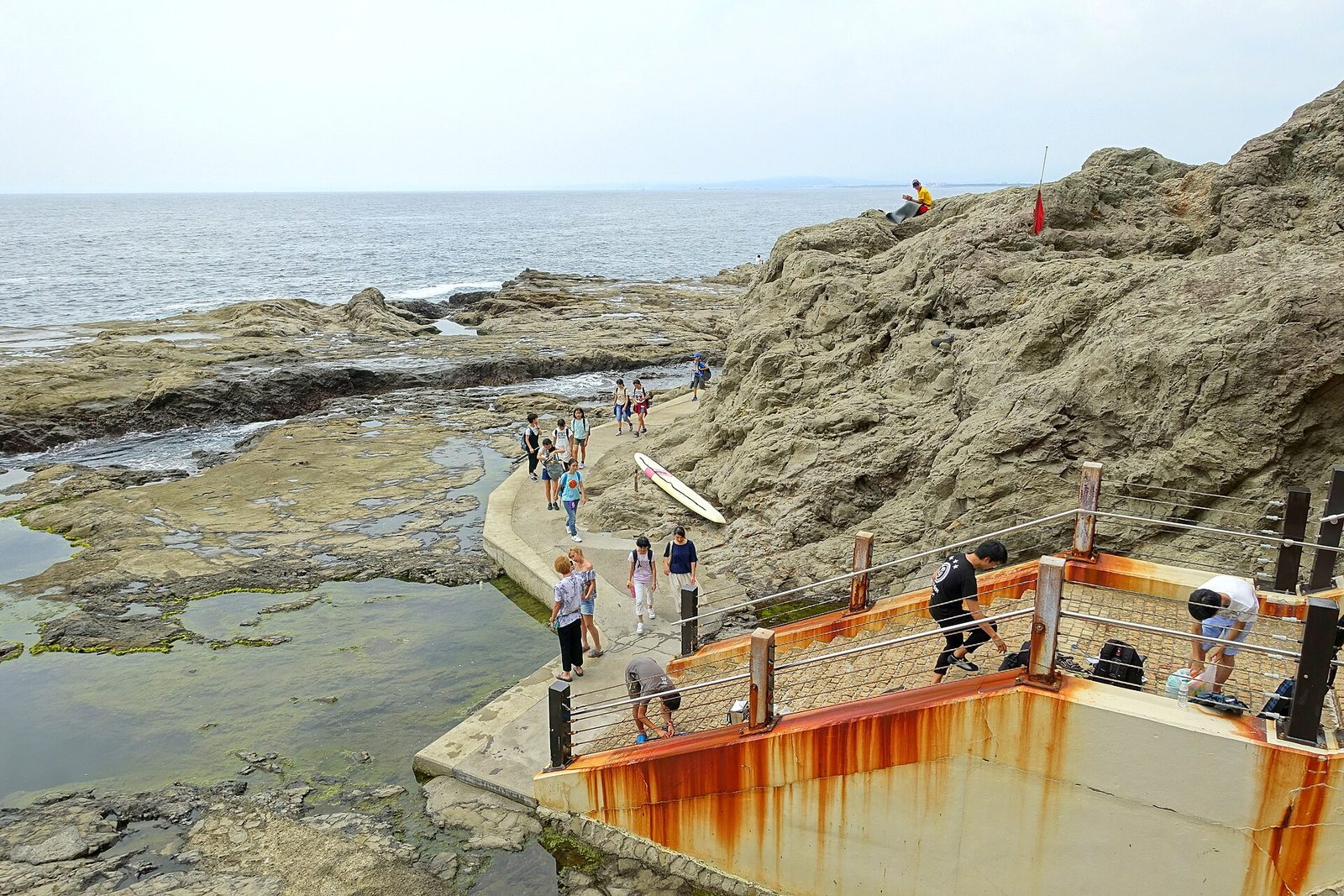
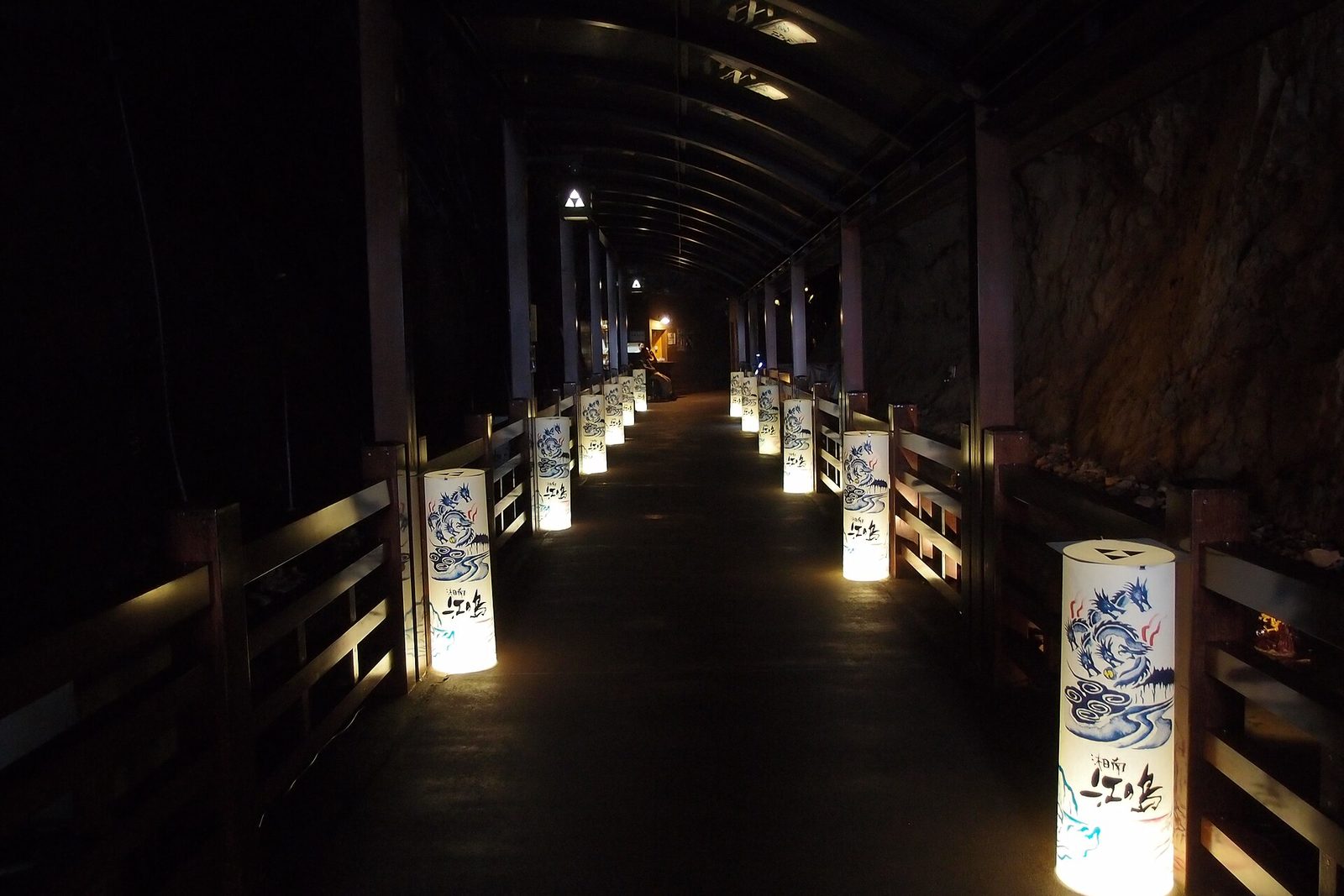
Getting back from the caves to the approach means climbing over the island again: 25–30 minutes. Have lunch on the approach or near the bridge: a whitebait bowl. Sagami Bay is big whitebait (shirasu) country, and eating it raw, fresh off the boat, is a local treat.
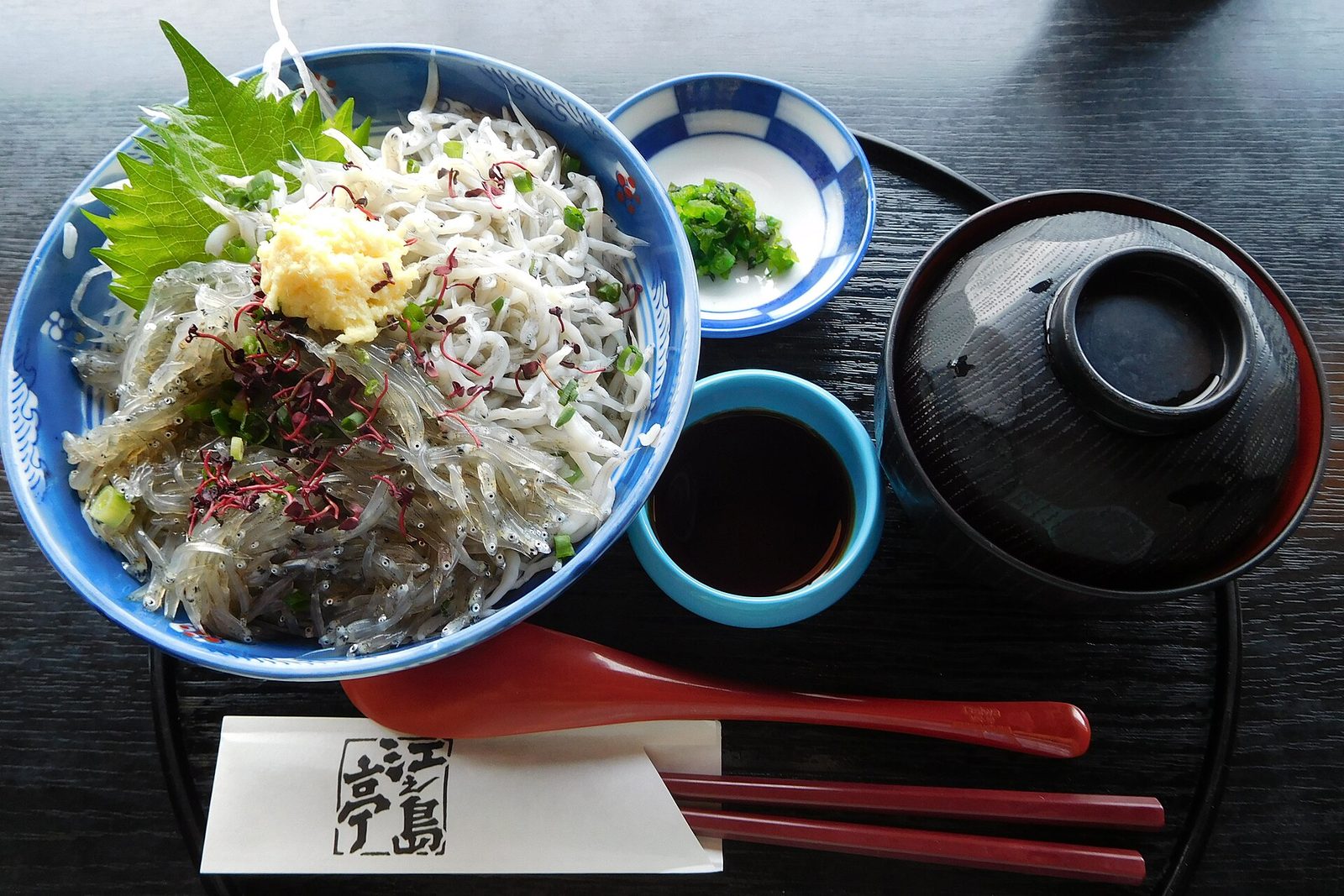
Raw whitebait is only served on days the boats went out. In rough weather, or in the closed season (1 January to 10 March), you get the boiled kind.
Walking the coast to ③ Kamakura-Kokomae
After lunch, cross back over the bridge and head east along the shore. Follow the seaward pavement of Route 134 past Koshigoe fishing port for 2.5 km, about 35 minutes, to Kamakura-Kokomae Station. Arriving on foot, with the coast running on towards Shichirigahama, shows the station at its best.
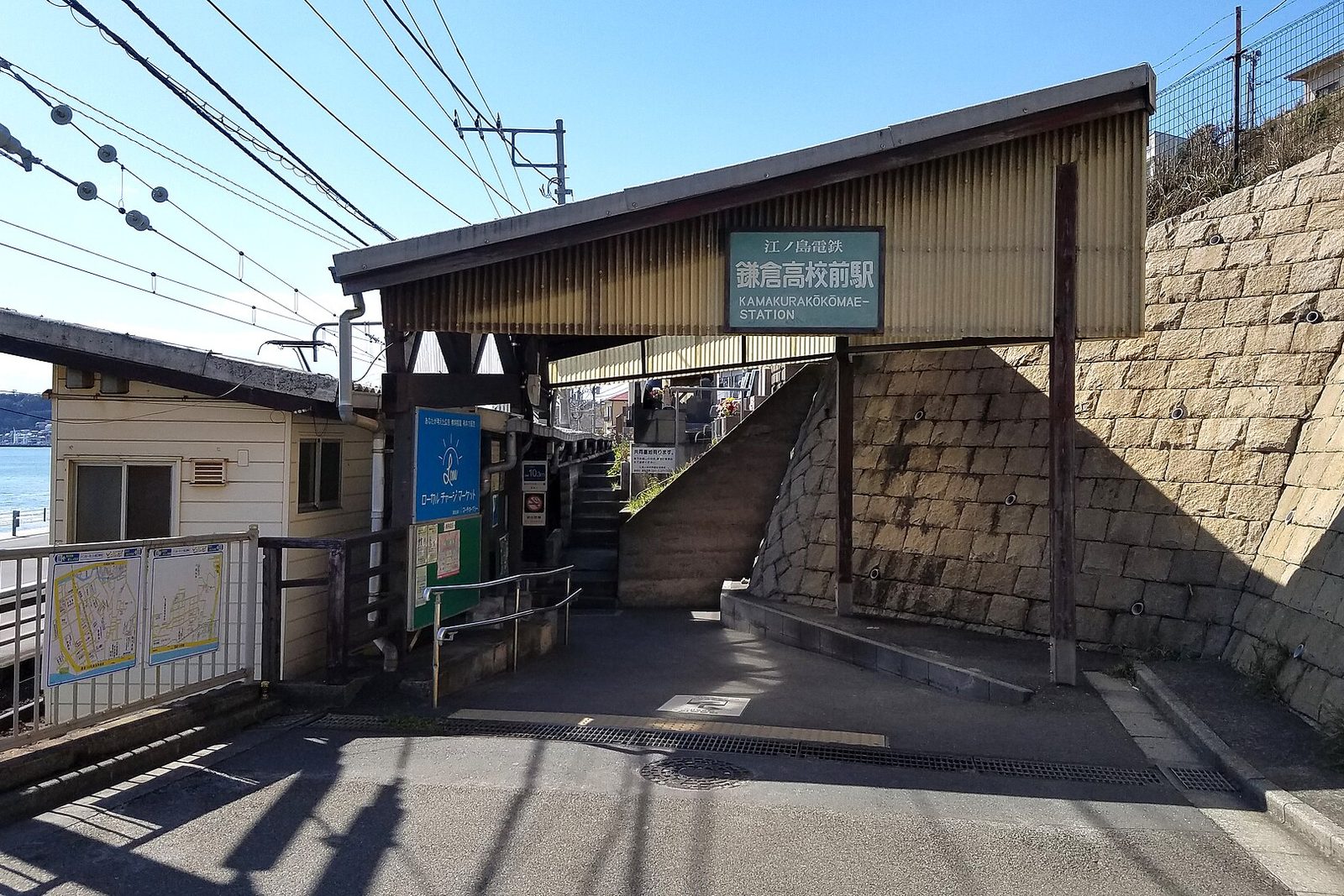
Kamakura-Kokomae is the Enoden at its most Enoden: the sea is right in front of the platform. The level crossing beside it, Kamakura-Kokomae No. 1, is known from the opening of the anime SLAM DUNK, and draws visitors from Japan and abroad to photograph it. Looking down the slope to the crossing and the sea beyond: that is the shot.
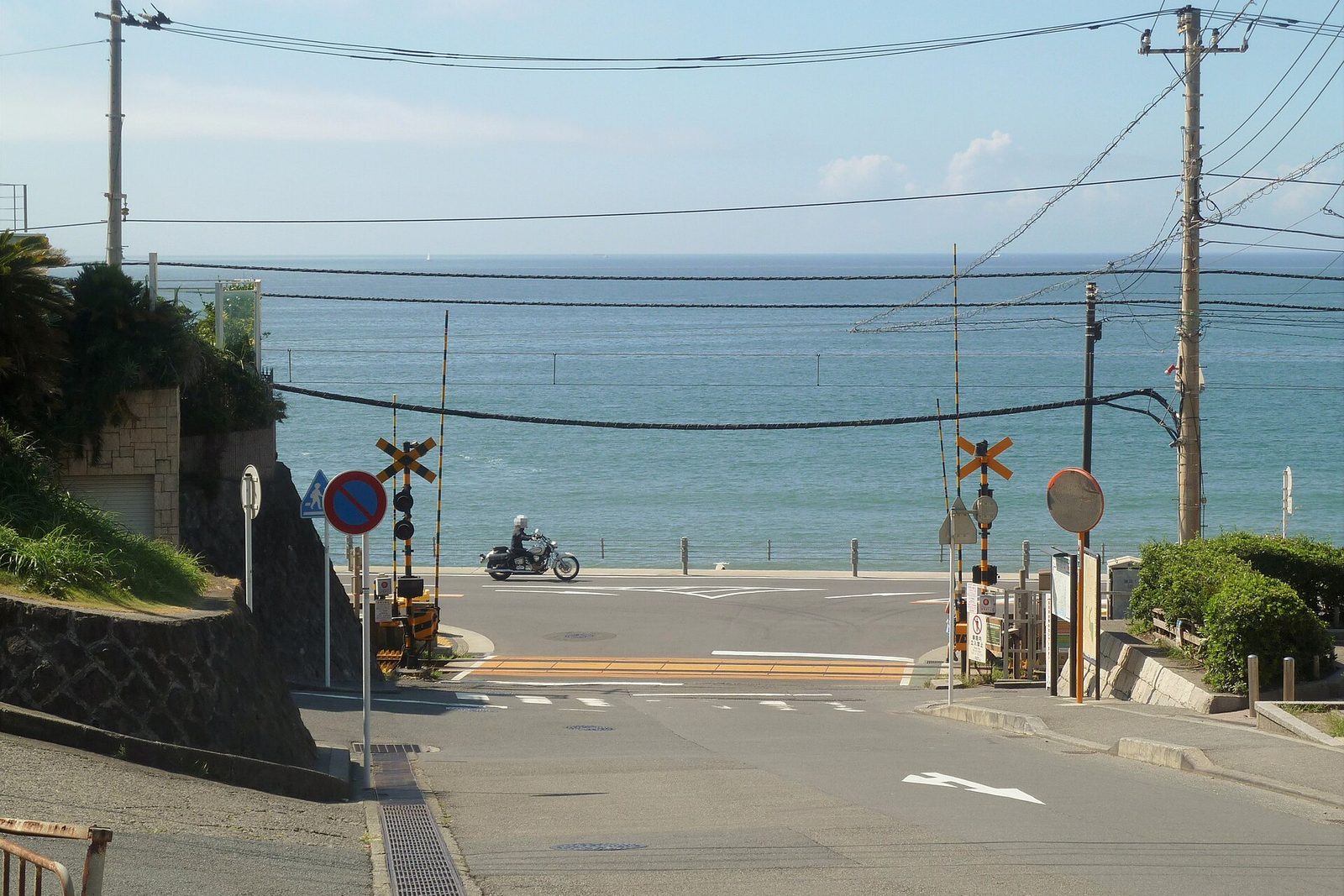
I would have liked to put the anime frame here too, but scenes from the show belong to its rights holders, so they are not reproduced. Instead there is a photo from the same slope looking down at the crossing and the sea. To compare, watch the show itself.
Because the spot is so popular, Kamakura City asks visitors for a few things. Keep to them so everyone can get their photo:
- Shoot from Koshigoe Rakko Park — the city points visitors to this small park right by the crossing
- Don’t stop in the road or on the crossing — cars use the slope. Don’t block the pavement either
- Stay off private property — the area is homes and shops; don’t step into gardens or car parks for a shot
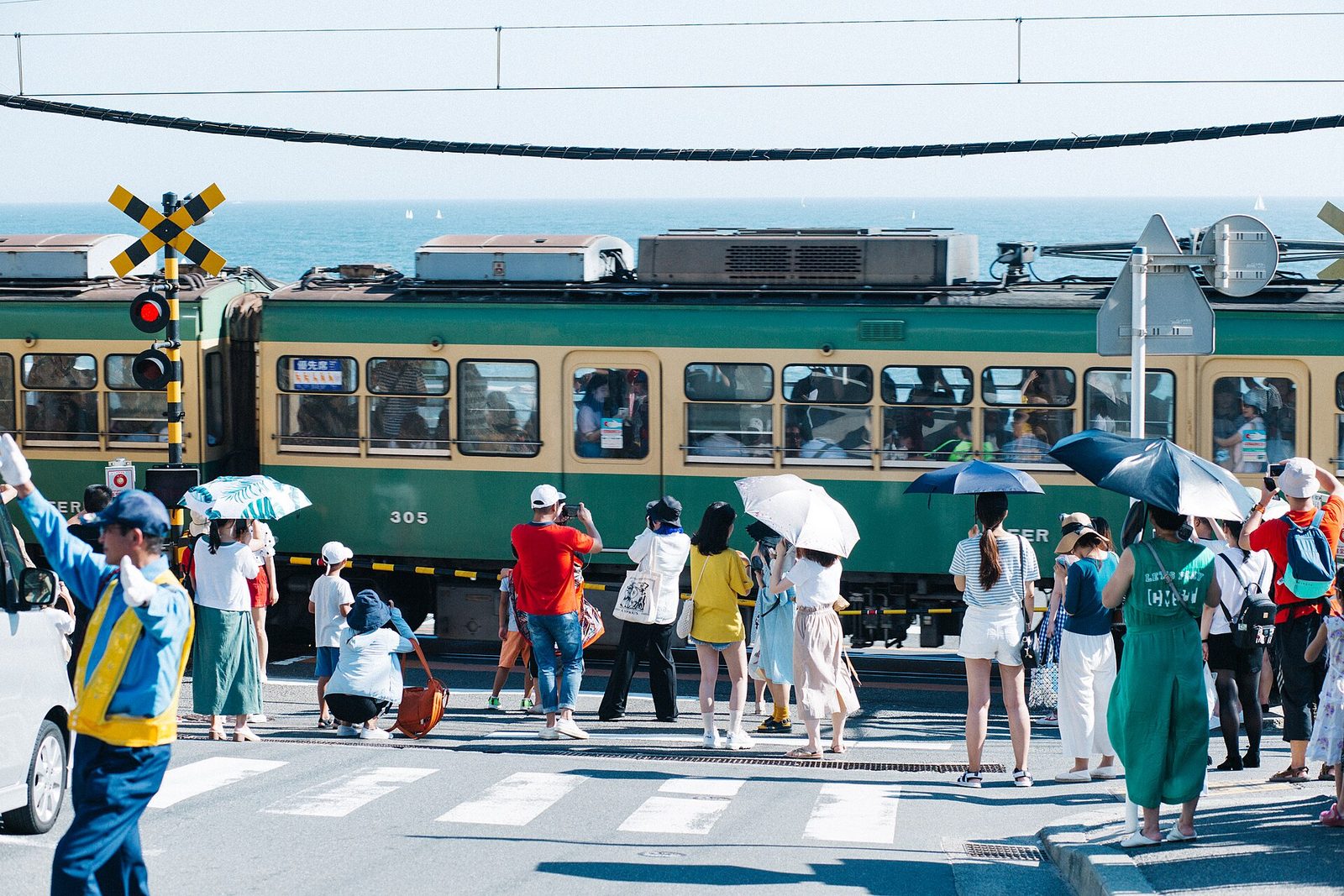
Weekends and holidays are busy; from October 2025 to March 2026 stewards were posted here, and since February 2026 the city has used AI cameras to study how crowds move around the crossing.
The Enoden to ④ Hase
From Kamakura-Kokomae, take an Enoden train towards Kamakura and get off at Hase 15 minutes later. Sit on the right and the sea stays with you past Shichirigahama and Inamuragasaki. After the tunnel at Gokurakuji you are almost there.
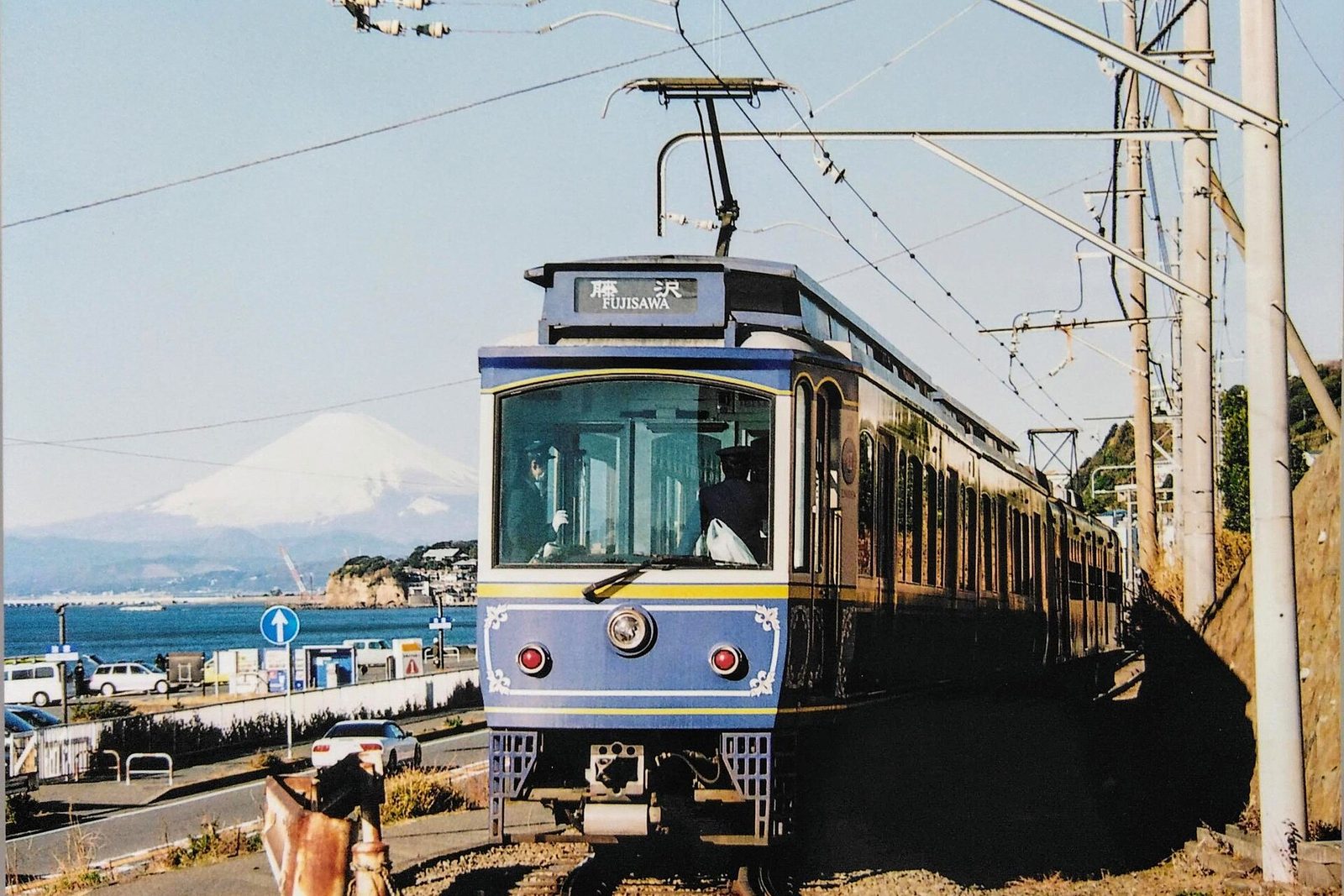
Hase is the highlight of the line: the Great Buddha (Kotoku-in) and Hase-dera are five minutes apart on foot, and the Buddha is about seven minutes from the station. Go to the Buddha first, then call at Hase-dera on the way back.
Kotoku-in (the Great Buddha)
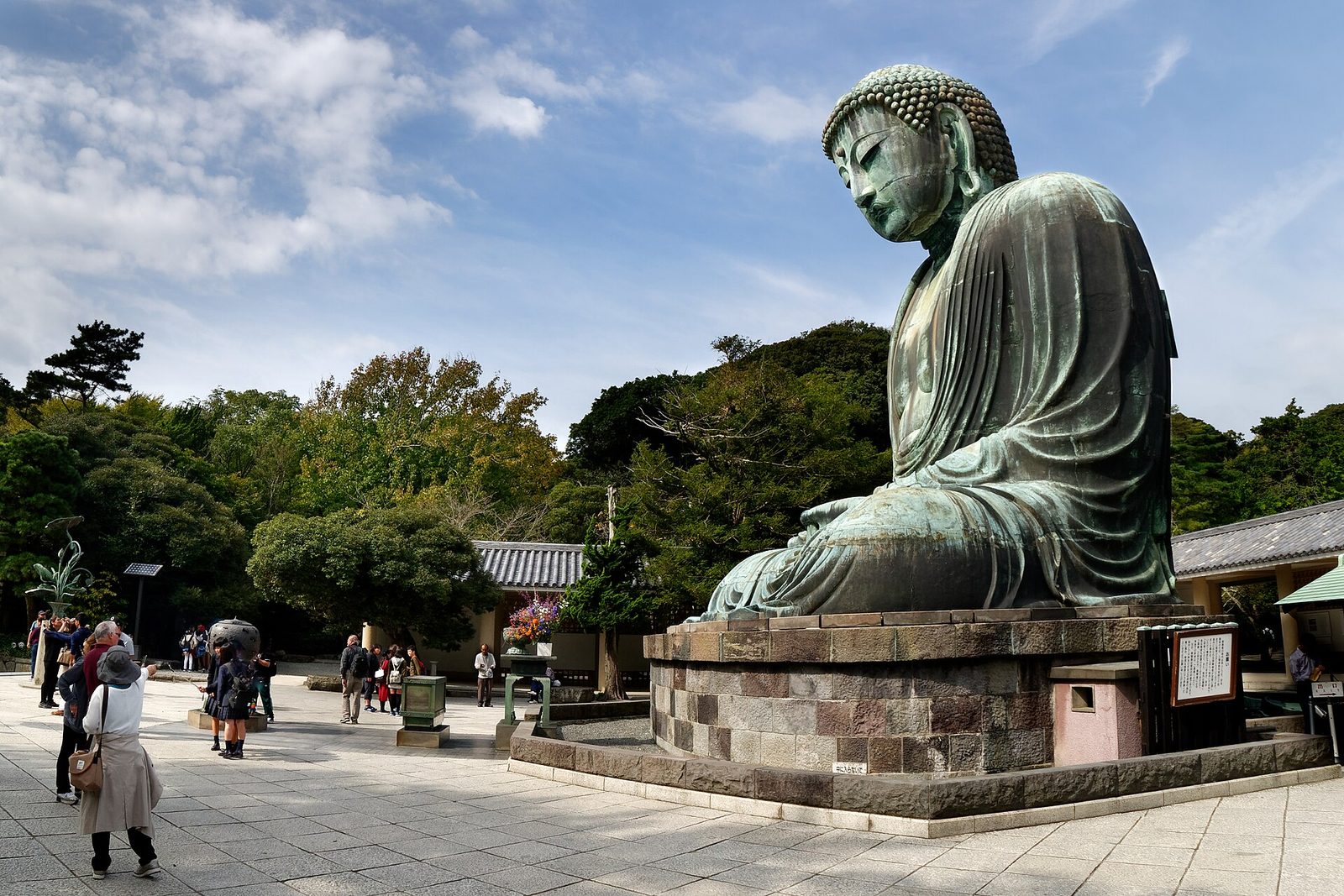
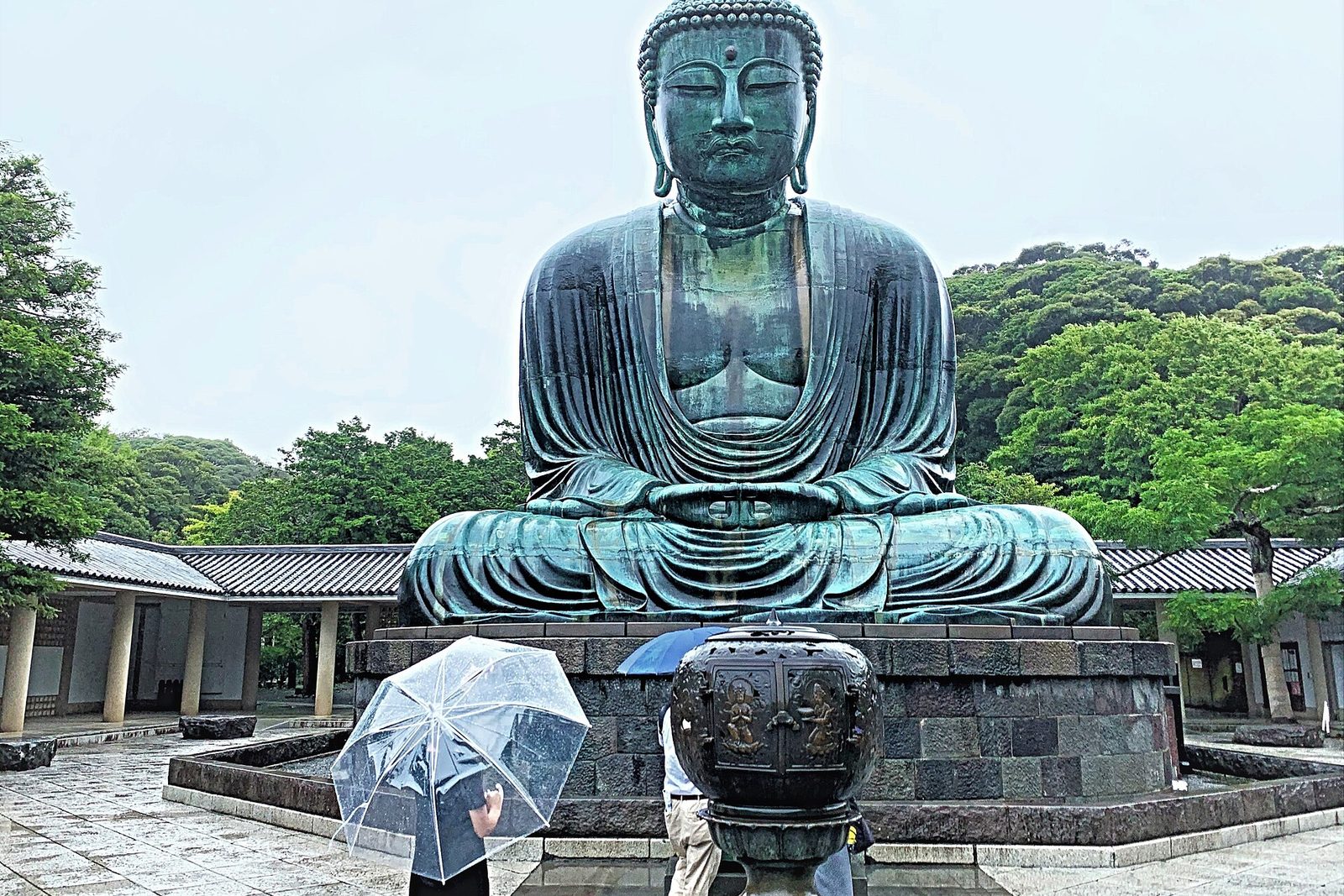
- A National Treasure — a bronze seated Amida Buddha, begun, by tradition, in 1252. It once sat inside a hall; after disasters destroyed it, the Buddha has sat in the open air since around the end of the 15th century
- Inside the Buddha — you can step inside and see how the statue was cast (8:00–16:30, ¥50)
- Hours and rules — October to March 8:00–17:00 (last entry 15 minutes before closing), ¥300. No eating or drinking in the grounds
Hase-dera
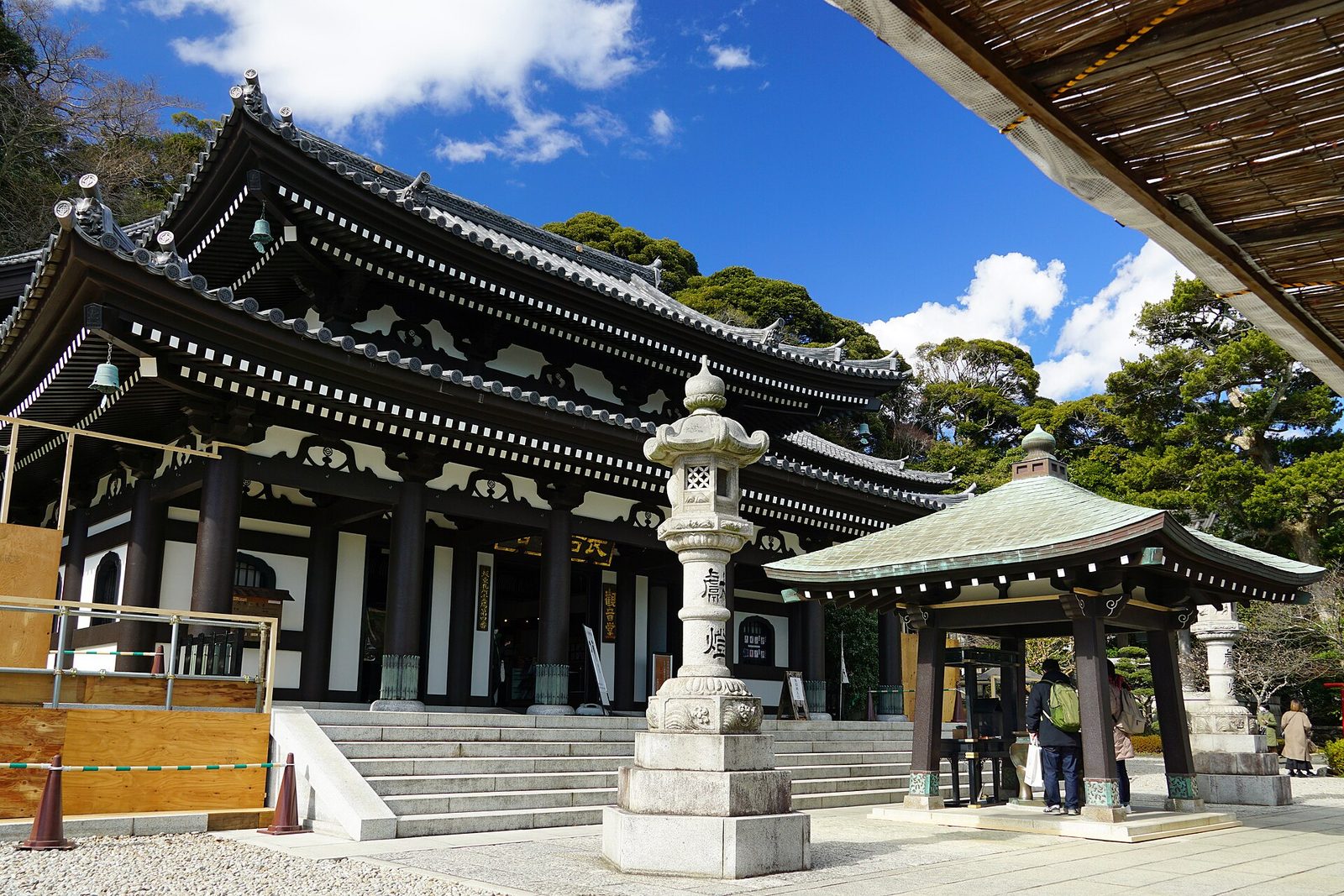
- The Kannon hall — home to a wooden eleven-headed Kannon more than 9 m tall
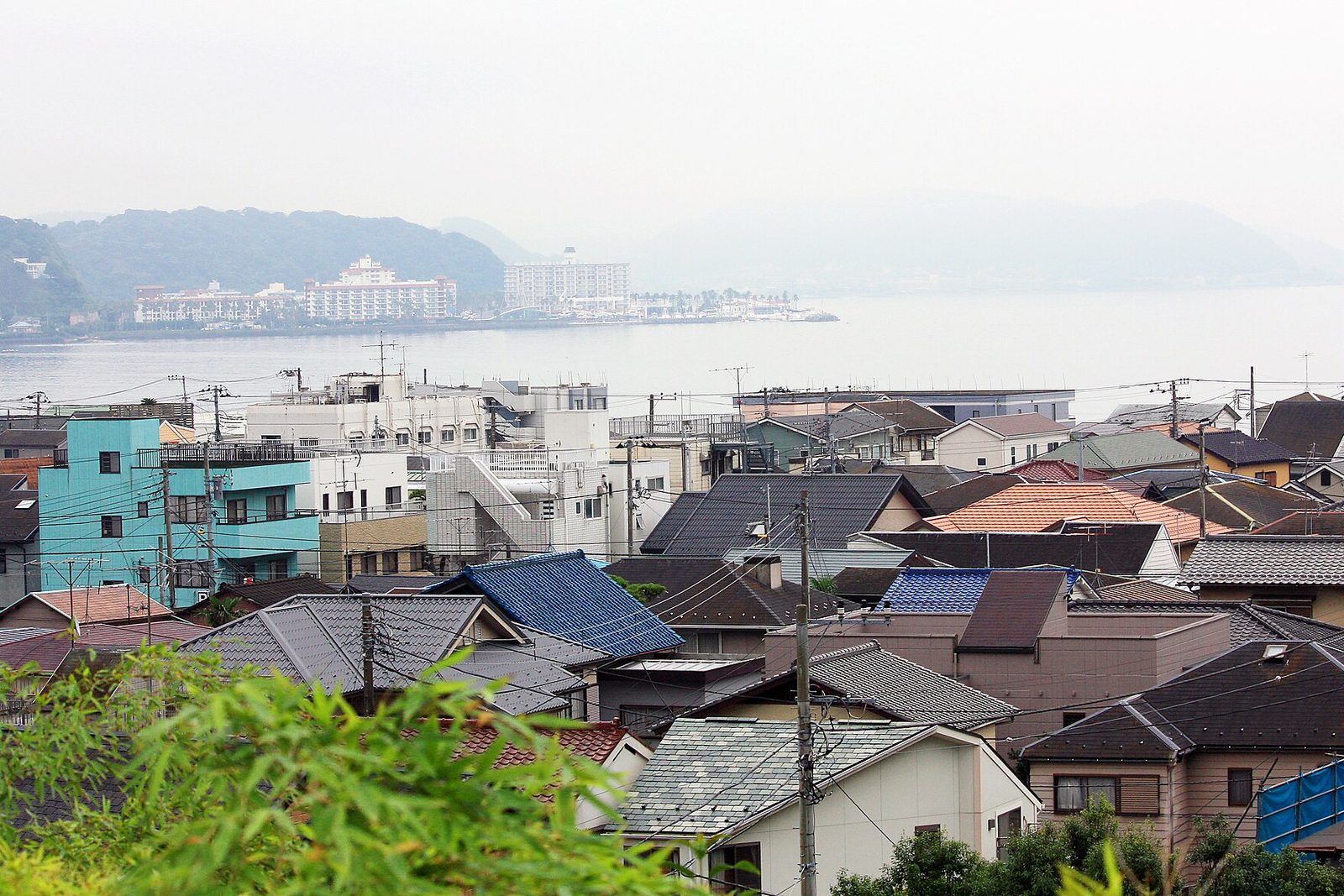
- The lookout — from halfway up the hill you look down over Yuigahama: the day’s best view of the Kamakura sea
- Hours — entry 8:00–16:30 (to 17:00 April to June), ¥400. Five minutes’ walk from Hase Station
⑤ Kamakura: Komachi-dori & Hachimangu
Four minutes on the Enoden takes you to the end of the line at Kamakura. Out of the JR east exit, the red torii of Komachi-dori is right in front of you. Walk north through the shops and you reach Tsurugaoka Hachimangu.
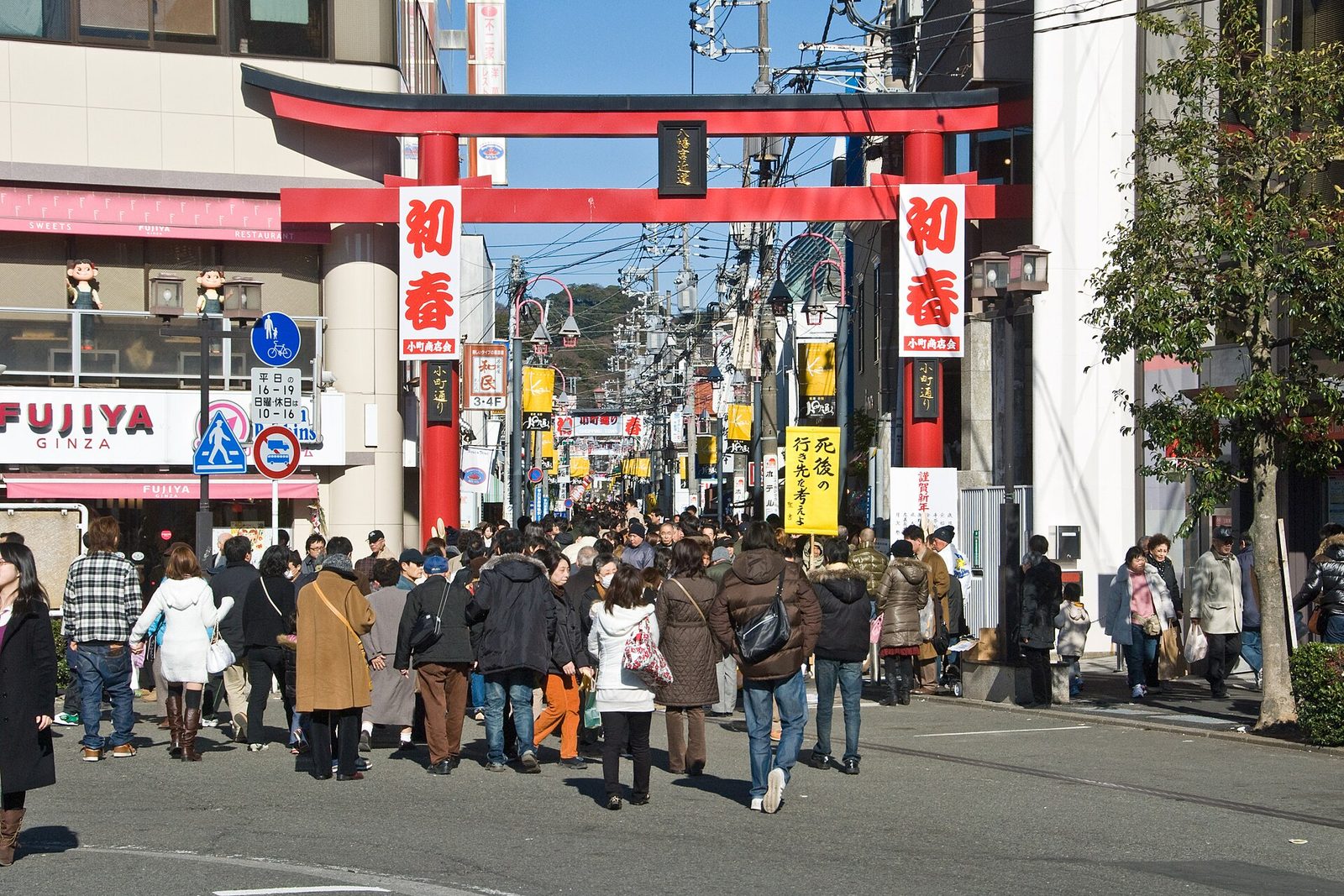
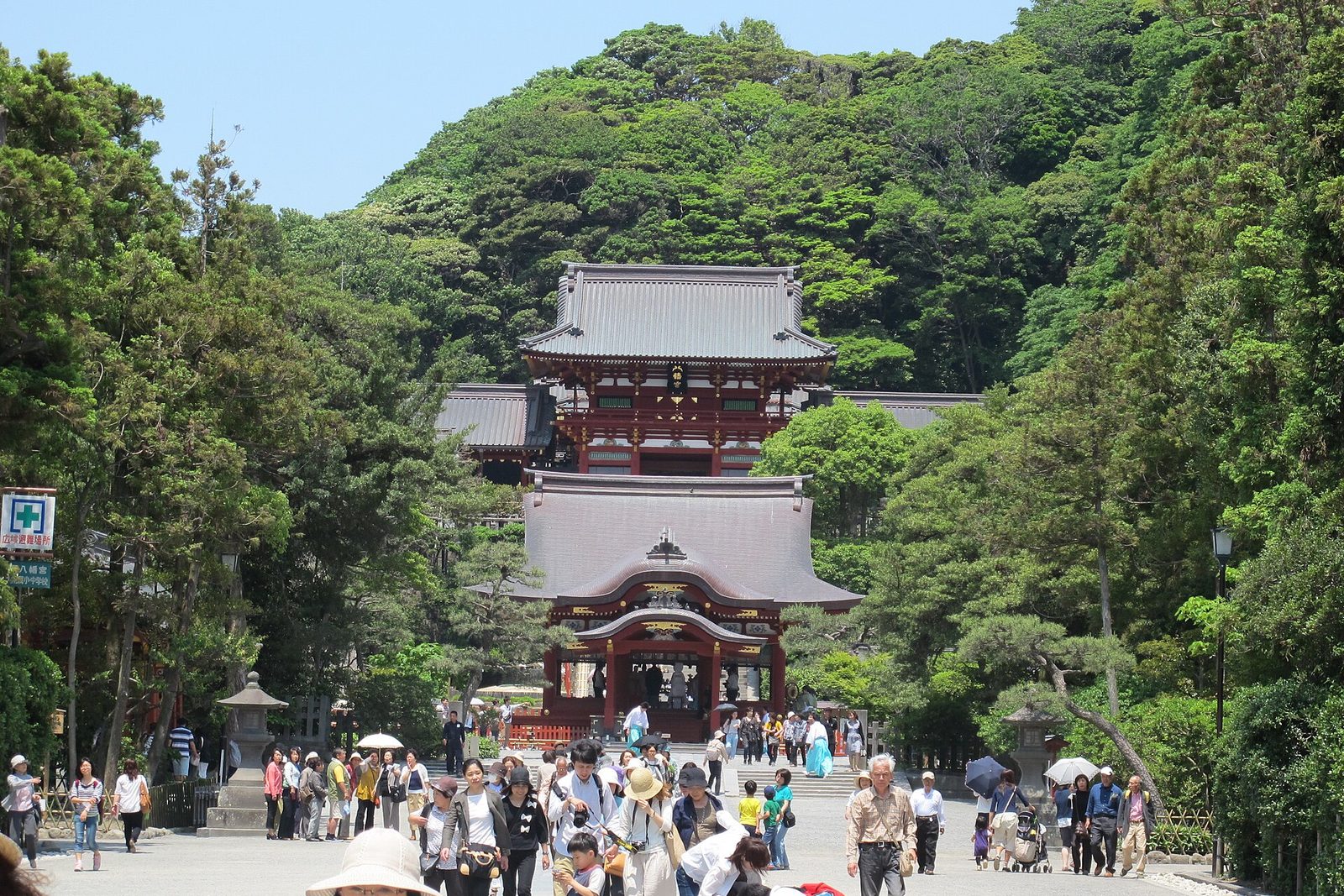
Minamoto no Yoritomo moved Tsurugaoka Hachimangu to this spot as he founded the Kamakura shogunate, and it remains the heart of the town. Wakamiya-oji, the avenue that runs straight from the sea to the shrine, was laid out as its approach. It is a fitting place to end the day and see how Kamakura came to be.
- Komachi-dori — about 360 m of sweet shops, rice-cracker stalls and gift shops. Some close early in the evening, so go to the ones you want first
- Tsurugaoka Hachimangu — open 6:00–20:00 all year, so an evening visit is fine. From the main shrine at the top of the great stairway you can see Wakamiya-oji running straight towards the sea
- Heading back — the raised walkway down the middle of Wakamiya-oji, the Dankazura, takes you to the station in about 10 minutes. Leave the shrine at 18:00 for the 18:13 train
Adjusting on the day
The beauty of this route is that the Enoden half can be reshuffled freely. Adjust for the weather, your legs and the crowds.
| If… | Then… |
|---|---|
| You fall behind on Enoshima | Skip the caves and turn back at Okutsu-miya to save about 40 minutes, or walk the garden without going up the tower |
| The steps are hard going | Take the Escar up. The Enoshima 1day ticket (¥1,550) bundles it with the tower and caves |
| You have time to spare | Hop off the Enoden: Inamuragasaki (sea, Fuji, sunset), Gokurakuji (a tiny station and an old temple), or walk from Hase to Yuigahama beach |
| You’ll ride the Enoden a lot | The Noriori-kun day pass (¥800). Not worth it for this plan’s two rides (¥420) |
| The Enoden is packed | Kamakura-bound trains fill up on weekend afternoons. Hase to Kamakura is 20–25 minutes on foot |
| It rains | The caves close in rough weather and Chigogafuchi gets dangerous. Keep Enoshima to the shrines and garden, and give more time to Hase-dera and Hachimangu |
| It’s Shonan Candle season | From 10 October to 3 November the Samuel Cocking Garden is lit with candles in the evening. Try the route in reverse: Kamakura first, Enoshima at dusk |
Before you go
- Wear good shoes — Enoshima alone is a lot of steps, and the path by the caves can be wet. Expect around 10 km on foot over the day
- Earlier is easier — Enoshima and the Enoden both get busier as the day goes on, which is why this plan leaves Tokyo just after eight
- Eating on the move — a Kamakura City ordinance asks visitors not to eat while walking in crowded places. On Komachi-dori, eat at the shop, then walk on. No food or drink in the grounds of Kotoku-in
- Peak-season Enoden — in big holiday periods, Kamakura’s Enoden station sometimes gives local residents priority entry (as in Golden Week 2026), and visitors queue outside. Allow extra time
- Check the times — the times here are one example from the October 2026 Saturday timetable. Weekday and holiday services differ, so check a route planner the day before
§ — On one page
- The 8:05 Tokaido Line from Tokyo to Ofuna, then the Shonan Monorail to Enoshima by 9:07. Home on the 18:13 from Kamakura, Tokyo at 19:06.
- Walk Enoshima end to end in the morning: the approach, the three shrines, the Sea Candle, Chigogafuchi and the caves. Whitebait for lunch.
- In the afternoon, walk 35 minutes along the coast to Kamakura-Kokomae. Photograph the crossing from Koshigoe Rakko Park, off the road and off private land.
- The Enoden to Hase for the Great Buddha and Hase-dera, then Komachi-dori and Tsurugaoka Hachimangu in Kamakura.
- Budget about ¥8,000 per person. An IC card is all the ticket you need. Reshuffle the second half for weather and crowds.
References
- Shonan Monorail — tickets and fares (Japanese)
- Enoshima Shrine — visitor guide (Japanese)
- Enoshima Sea Candle — tickets (Japanese)
- Fujisawa City Tourism Association — Enoshima Iwaya (Japanese)
- Kamakura City — for visitors to Kamakura-Kokomae Station (Japanese)
- Enoshima Electric Railway (timetables and fares)
- Kotoku-in (the Great Buddha), official site
- Hase-dera — visitor guide (Japanese)
- Tsurugaoka Hachimangu — access (Japanese)
- Geospatial Information Authority of Japan — GSI tiles (map imagery)
Photos are from Wikimedia Commons under licences that permit reuse; the author and licence are credited under each one. Map imagery is from the Geospatial Information Authority of Japan, with roads and rail from OpenStreetMap data (the open sea has been evened out in colour to hide seams between photos taken at different times). Times were checked with the NAVITIME route planner against the October 2026 Saturday timetable; prices and hours are as of September 2026 and may change.
Travel Notes No. 3 — Enoshima and Kamakura in a Day / 2026.09